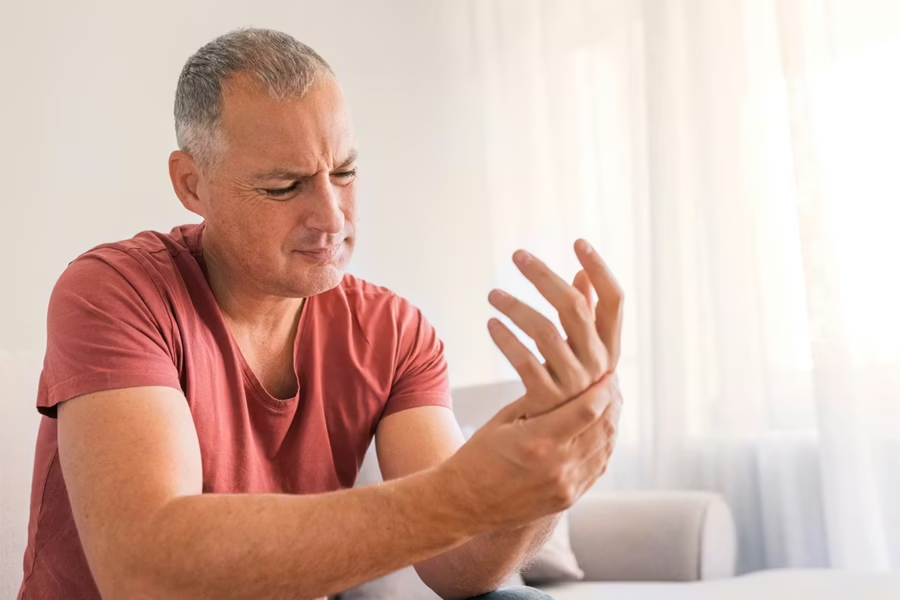
Muscle stiffness is often a sign of a common secondary effect of stroke called spasticity. About 2 out of every 3 stroke survivors experience some form of spasticity or muscle stiffness, according to the National Stroke Association.
This article will discuss the causes and symptoms of muscle stiffness after stroke, as well as treatment interventions to help relax the affected muscles.
What Causes Muscle Stiffness After Stroke?
To understand what causes muscle stiffness after stroke, let’s review how movement occurs.
Normally your muscles and brain are in constant communication. Your muscles tell the brain how much tension they’re under, and your brain tells your muscles how and when to move.
When a stroke damages the areas of the brain that control movement, it impairs the brain’s ability to communicate with the muscles. As a result, your muscles may become “over-active” and remain in a state of contraction, which causes stiffness.
Involuntary muscle contractions caused by damage to areas in the brain that regulate movement are more formally known as spasticity. In its milder forms, individuals may experience muscle stiffness but still be able to move the muscle through its range of motion. But in its more severe forms, spasticity can significantly affect mobility.
When a person has spasticity, it is often increased by movement and is velocity-dependent, which means the more rapidly a muscle is stretched, the more severely it will contract. However, spasticity can also be present at rest, as sometimes severe spasticity causes muscles to stay in a prolonged state of contraction.
Now that you understand what causes muscle stiffness after stroke, let’s discuss how it affects the body.
Signs of Spasticity After Stroke
Muscle stiffness after stroke can affect everyone differently. Spasticity can range from mild to severe and affect different parts of the body.
• Common signs of muscle stiffness after stroke include:
• Limited range of motion
• Joint and muscle pain
• Rigid, awkward movements
• Spasms or jerky movements
• Discomfort
• Difficulties with coordination
• Inability to voluntarily relax the muscles
• Body parts remaining in atypical resting positions, such as arm or hand curled up
Various factors can contribute to the severity of muscle stiffness including physical activity levels and the severity and location of the stroke.
Without effective management, spasticity after stroke can progress into extremely (and permanently) tight muscles (and possibly tendons, skin, and other nearby tissues), to the point where movement of a joint is prevented – a condition called contractures.
An example of contracture is when a survivor’s affected hand tightly clenches into a fist to the point that the fingernails may dig into the survivor’s palm. This atypical positioning of the hand could be seen with severe spasticity, and then later may progress to a contracture (where the hand can no longer be fully opened because the muscles have permanently shortened, as with a contracture).
Contractures are a serious condition that are essentially irreversible, so it’s important to prevent them from happening in the first place by managing spasticity.
Research on stroke recovery often points to neuroplasticity when looking at how spasticity changes over time.
What Research Says About Neuroplasticity and Spasticity
Neuroplasticity is the term researchers use for the brain’s ability to adapt and form new connections.
When connections between the muscles and brain are damaged by stroke, they do not regenerate. Research describes the brain as able to adapt over time, with other regions taking on some of the affected functions, and studies look at how that adaptation relates to spasticity.
Research in this area often focuses on repetition, sometimes called massed practice. The more you practice moving weakened functions, the more stimulation the brain has to work with.
Be aware, however, that many exercises for spasticity are meant to be completed slowly and gradually, so be careful not to rush through them just to get more repetitions. When completed intentionally with proper form, consistent and repeated practice is what the research focuses on.
How to Treat Muscle Stiffness After Stroke
Because everyone experiences spasticity differently, a personalized approach to treatment is ideal.
What works for some may not be as effective for others. Therefore, it is recommended to work with a team of rehabilitation specialists to optimize your recovery outcomes.
Below, we’ll discuss some of the best treatments for stiff muscles after stroke:
1. Physical and Occupational Therapy Exercise
By working with physical and occupational therapists, you can target specific muscles and practice exercises and activities that will promote neuroplasticity and long-term spasticity relief.
Physical therapists focus on stimulating the mind-body connection through exercise. They’ll guide you through stretches, range of motion exercises, and strengthening exercises to promote neuroplasticity.
When spasticity is affecting your upper body (i.e. your arms and/or hands), occupational therapists will teach you stretches and exercises to minimize the spasticity there as well. Since spasticity, if severe, can make it difficult to use your arm functionally, they will also have you practice everyday activities or teach you to use adaptive tools to help you become more functional and independent after a stroke.
Both rehabilitative therapies emphasize the importance of continuous practice to develop better mobility.
See all the spasticity treatment exercises »
2. Passive Exercise
If you struggle with post-stroke paralysis, then you may find it difficult to do active therapy exercises. However, don’t give up! You can still do passive exercises by assisting your affected muscles through the movement. Use your non-affected side or the help of a trained caregiver or therapist.
Although you aren’t “doing it yourself,” passive exercise is still studied as a way to engage neuroplasticity. Research looks at whether repetition over time is linked to changes in movement.
See how passive exercise works »
3. Range of Motion Exercise
At the very least, try to move your affected muscles safely through their range of motion multiple times a day. Stretching is important for preventing spasticity from getting worse, along with preventing other post-stroke complications like pressure sores (if you’re bedridden or use a wheelchair regularly).
See all ROM exercises for stroke patients »
4. Electrical Stimulation
Another great way to relieve stiff muscles after a stroke is to apply electrical stimulation. This helps stimulate the brain and encourages neuroplasticity.
Combining electrical stimulation with physical and occupational therapy exercises is proven to create better results than just therapy exercises alone.
Talk to your therapist to see if it’s a good fit for you and learn where to place the electrodes. Do not use electrical stimulation if you have a pacemaker.
Learn more about electrical stimulation for stroke recovery »
5. Botox
If you struggle with severe spasticity, then you may have difficulty doing exercises because your muscles will be too stiff.
To help loosen things up, talk to your doctor or therapist about Botox injections. Botox is a nerve block that helps temporarily relieve spasticity.
Although the effects will wear off after 3-6 months, you can use this “window of opportunity” to get some spasticity treatment exercises done. This will address the root problem and lead to long-term improvement.
Learn more about Botox for stroke recovery »
6. Medication
Muscle stiffness after stroke can also be treated with medication like Baclofen. This medication can be taken orally, or you can get a pump surgically implanted that releases a continuous supply. Talk to your doctor to see if it’s a good fit for you.
Side effects from these medications can be severe, so carefully weigh your options. It could be beneficial to try therapy and electrical stimulation first because they are less invasive and have little to no side effects.
Learn more about medication for spasticity »
7. Splints and Orthotics
If you struggle with clenched hands after stroke or spastic foot drop, then you may benefit from hand splints or ankle-foot orthotics.
Talk to your therapist to get recommendations for adaptive equipment that may help you.
Adaptive equipment does not address the root problem, but it improves your safety so that you don’t fall or hurt yourself. It also helps prevent contractures.
Make sure you’re also engaging in spasticity treatment exercises to address the root problem and you’ll be on the road to recovery.
See types of gloves for stroke patients »
8. Acupuncture
Acupuncture is a stiff muscle treatment that has some clinical evidence behind its effectiveness.
Particularly, when you combine therapy exercises with acupuncture, it helps improve spasticity more than exercise alone – just like electrical stimulation.
In fact, some acupuncturists can apply electrical stimulation to the needles used during treatment, so the modalities have some commonalities.
Like e-stim, acupuncture has little to no adverse side effects. It’s worth trying if you can afford it.
Learn more about acupuncture for stroke recovery »
Understanding Muscle Stiffness After Stroke
Muscle stiffness after stroke is often a sign of spasticity, which affects 2 out of every 3 stroke survivors.
Depending on the severity of muscle contractions, treatments can vary significantly from person to person. That being said, research into long term spasticity looks at the connection between the brain and the affected muscles, and points to repeated, task focused movement as the area of study.
This article is general information, not medical advice. Results vary from person to person, so talk with your care team about what is right for you. We hope it helped you understand muscle stiffness after stroke and what can help with spasticity over time.