Home / Blog /

Medthera Launches WalkPort: A Supported Walk Station That Brings Daily Rehab Home for People with Mobility Challenges

Medthera Launches WalkPort: A Supported Walk Station That Brings Daily Rehab Home for People with Mobility Challenges

WACONIA, Minn., April 21, 2026 /PRNewswire/ — Medthera, Inc. today announced the launch of WalkPort, a supported walking station designed to help individuals with mobility challenges safely stand and practice walking therapy at home and in clinical settings.

WalkPort addresses a significant gap in mobility care: the limited ability for individuals to practice walking safely and consistently outside of therapy sessions. For people living with conditions such as stroke, spinal cord injury, Parkinson’s disease, multiple sclerosis, and age-related mobility limitations, regular movement can play an important role in maintaining strength, mobility, and independence.

This need for consistent, accessible movement—combined with the founder’s firsthand experience with mobility loss—led to the development of WalkPort.

“Walking is more than movement—it’s independence,” said Alan Tholkes, Founder of Medthera and a long-time quadriplegic wheelchair user. “I saw firsthand how limited access to consistent therapy slows progress. WalkPort was built to give people a safe way to practice walking every day, whether at home or as part of their therapy program.”

Alan Tholkes, founder of Medthera, is a lifelong innovator in mobility and rehabilitation. After a car accident in 1976 left him with a spinal cord injury and unable to walk, he dedicated his life to improving mobility and independence for others facing similar challenges.


Expanding Access to Walking Therapy at Home and in Clinical Settings
Unlike traditional mobility aids or treadmills, WalkPort provides full-body support and guided motion designed specifically for individuals with significant mobility challenges.

Key features include:

  • Powered sit-to-stand assistance for safe transitions
  • Stabilizing supports to maintain alignment and reduce fall risk
  • Guided walking motion to encourage natural gait patterns
  • Companion app that tracks steps, cadence, and standing and walking time, helping users to monitor progress


By reducing fear of falling, WalkPort enables users to focus on consistent, repetitive movement—key drivers of functional improvement.

For rehabilitation providers, WalkPort offers a way to increase access to walking therapy, support higher repetition during sessions, and help bridge the gap between in-clinic care and home-based therapy.

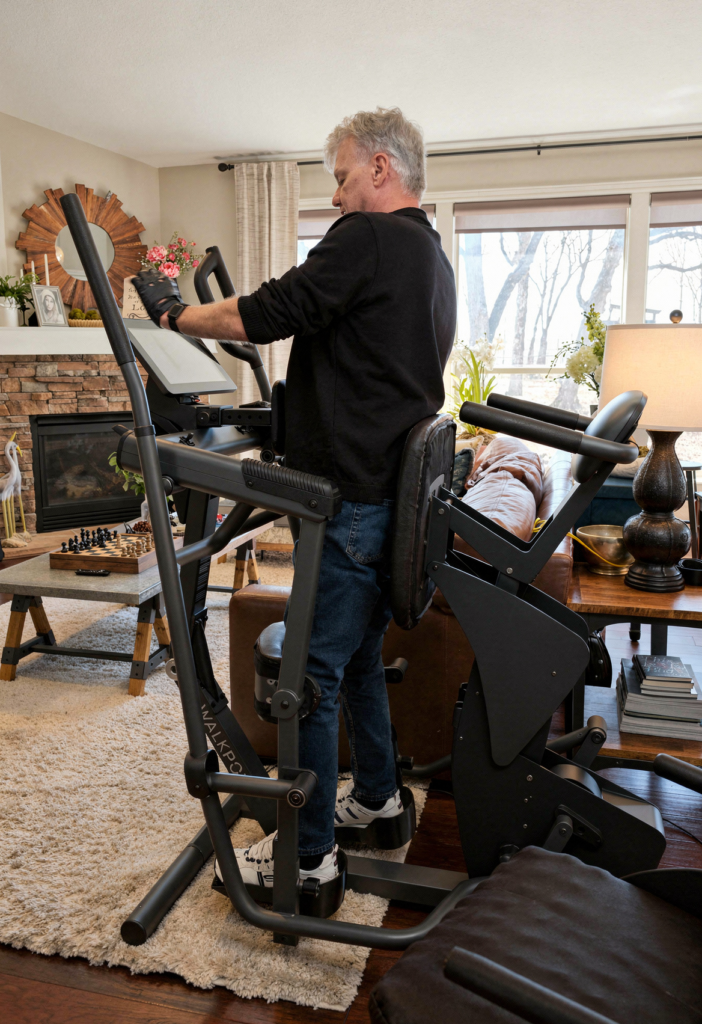
WalkPort, a supported walk station that allows people with a mobility issue stand up and do walking therapy at home. It provides consistent support and enables users to focus on proper movement and gait practice while feeling comfortable and supported during each session.


Supporting Long-Term Mobility and Independence
WalkPort is designed not only for rehabilitation, but also to support ongoing mobility and physical function for individuals living with chronic and progressive conditions.

For users with conditions such as Parkinson’s disease, multiple sclerosis, and spinal cord injury, consistent access to safe, guided movement can play an important role in maintaining strength, mobility, and overall health.

Early users report improvements in strength, endurance, and confidence, along with the emotional benefit of standing and moving more regularly.

“My core strength is much better. Before I started using WalkPort daily four weeks ago, it took significant effort to stand up from a chair. Now, I do it almost without thinking.” — Paul, 54, living with Parkinson’s disease


Availability
WalkPort is now open for reservations with a deposit. Initial shipments are expected to begin in August 2026.


About Medthera, Inc.
Medthera is focused on advancing mobility through innovative assistive technology. Founded on firsthand experience with paralysis, the company is dedicated to helping individuals maintain and restore their ability to stand and walk.


Media Contact
Lisa Beringer, President
Medthera, Inc.
Phone: 952.855.1001
Email: 412512@email4pr.com
Website: www.walkport.com
Watch the Video: Resource Library – WalkPort

Leave a Reply

Your email address will not be published. Required fields are marked *

Recent Posts

Unlock Better Sleep with the Simple Act of Walking

At Medthera Inc., we understand how essential a good night’s sleep is to your overall health...

Understanding Muscle Stiffness After Stroke: How to Treat Spasticity

Muscle stiffness is often a sign of a common secondary effect of stroke called spasticity...
Kevin shares his inspiring full testimony at WalkPort.

We had the privilege of trying out Medthera’s new WalkPort machine for 30 days. First look at this product had me amazed at how compact it is, while adding more natural leg action into the design that can easily be adapted from a 6-foot patient to my 5-foot 2-inch wife. My wife, LuAnne, has been in physical therapy for 36 months. In that time, we have used 3 different styles of machines, most of which required one or two therapists to get her into. One took over 20 minutes to go from wheelchair to harness to the machine. Once in, one of the therapists would control the speed while the other would make sure LuAnne was OK and, in some cases, moving her leg. WalkPort does a fantastic job of addressing all the problems I have seen in the current style of machines on the market today.

The 3 area’s that I feel make it stand out.

1. The design is so easy to adjust to fit the patient. Once set up, the patient can do as much of the transfer from the wheelchair to the WalkPort as their disability will allow. In our case, LuAnne can roll up to the machine and get into the seat on her own. We have to position her right leg, which is paralyzed, into position and secure her foot. Once that is done, she can get herself to a standing position and start the motion of walking with no assistance from us. This allows her to walk for around a half hour quite easily.

2. The motion of the legs, knee and ankle is so close to actual walking movement, helping her re-establish the motor function of walking in her brain. The muscle gain and stamina were rather noticeable every day with major improvements over the course of our time with WalkPort. Towards the end of our 30 days, we had to limit LuAnne to an hour in the evening sessions as she was enjoying it so much.

3. The last and probably most valuable aspect is the attitude/excitement LuAnne expressed. She was incredibly proud of the work she was doing, especially how much of it she could perform unassisted. She always had a bright smile on her face when using the machine. She had gained such a boost in confidence while doing her exercises, from maneuvering around the machine on her own, to holding a standing position, to starting the motion of walking without assistance. She was very empowered seeing how much progress she was making on her own.

The size of this machine is about one-third the size of the other machines we had tried in the past. The first day we were introduced to the machine, LuAnne was in it and walking on her own within minutes. No motors controlling her stride. The enjoyment we saw on her face was so nice to see. Something else my daughter noticed was LuAnne walking forward for a while, then stopping and starting to walk backwards. I am not a therapist, but this seems to be a big deal to me.

In the end, LuAnne was able to gain muscle in her right leg and increase her stamina. We are still working on her walking on her own, but I am sure using this machine will reduce the time it will take to get to the next level of recovery.