
Home / Blog /

Breakthrough in Restoring Walking After Complete Spinal Cord Injury

Breakthrough in Restoring Walking After Complete Spinal Cord Injury

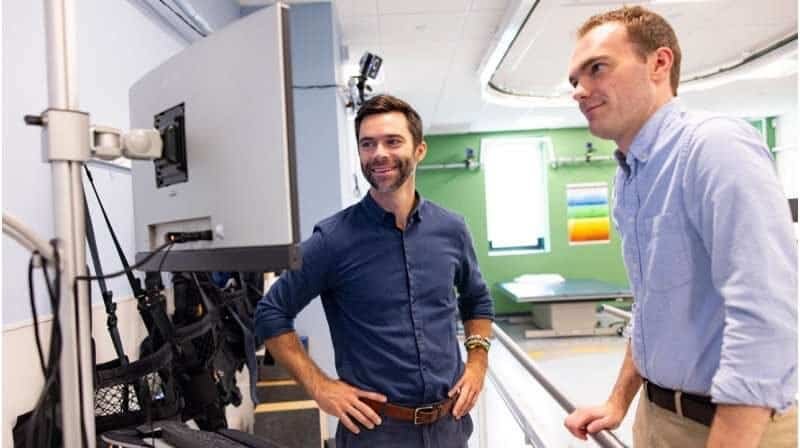
Researchers working on spinal cord injury recovery technology.

What Happened
A joint research team from Brown University, Rhode Island Hospital, and VA Providence Healthcare published a groundbreaking study in Nature Biomedical Engineering. They report that electrical stimulation placed above and below the injury site helped participants with complete spinal cord injury regain both muscle control and sensory awareness of their legs while walking on a treadmill.

How It Worked
Participants—three individuals who had lost all leg movement and sensation—received electrode implants both above and below their spinal cord lesions. This unique dual-stimulation method achieved:

  • Below-lesion stimulation: Enabled muscle activation, letting participants control leg movement.
  • Above-lesion stimulation: Restored sensory feedback, so participants could feel their leg position in space.

With therapist assistance, participants actively walk on a treadmill, monitoring both motion and sensation.

Why It’s A Big Deal

  • It’s the first-ever demonstration of simultaneous restoration of movement and sensation in people with complete spinal cord injuries.
  • This represents a major leap toward rebuilding the sensorimotor loop—the combined system of movement and sensory perception.
  • The innovation bridges a critical gap between neurological signaling above and below the injury.

What the Lead Researchers Said

“This is an important step toward the goal of fully bridging the gap created by a spinal lesion,”
David Borton, Associate Professor of Engineering, Brown University

Real-world Impact

  • This trial shows how next-gen walking technologies can move beyond mere muscle activation, adding meaningful sensory awareness.
  • It paves the way for more natural, coordinated movement, which is vital for regaining independence.
  • The results open new possibilities for commercial assistive devices and rehabilitation systems focused on both function and sensory experience.

Looking Ahead
The research team plans to:

  • Expand trials to more participants
  • Track long-term gains in balance and gait
  • Explore translating this method into portable or wearable systems — key for use outside the lab

📎 Source “Spinal stimulation above and below injury restores leg movement and sensory feedback in clinical trial,” MedicalXpress, March 11, 2026.
Read the full article here[medicalxpress.com]

Leave a Reply

Your email address will not be published. Required fields are marked *

Recent Posts

Unlock Better Sleep with the Simple Act of Walking

At Medthera Inc., we understand how essential a good night’s sleep is to your overall health...

Understanding Muscle Stiffness After Stroke: How to Treat Spasticity

Muscle stiffness is often a sign of a common secondary effect of stroke called spasticity...
Kevin shares his inspiring full testimony at WalkPort.

We had the privilege of trying out Medthera’s new WalkPort machine for 30 days. First look at this product had me amazed at how compact it is, while adding more natural leg action into the design that can easily be adapted from a 6-foot patient to my 5-foot 2-inch wife. My wife, LuAnne, has been in physical therapy for 36 months. In that time, we have used 3 different styles of machines, most of which required one or two therapists to get her into. One took over 20 minutes to go from wheelchair to harness to the machine. Once in, one of the therapists would control the speed while the other would make sure LuAnne was OK and, in some cases, moving her leg. WalkPort does a fantastic job of addressing all the problems I have seen in the current style of machines on the market today.

The 3 area’s that I feel make it stand out.

1. The design is so easy to adjust to fit the patient. Once set up, the patient can do as much of the transfer from the wheelchair to the WalkPort as their disability will allow. In our case, LuAnne can roll up to the machine and get into the seat on her own. We have to position her right leg, which is paralyzed, into position and secure her foot. Once that is done, she can get herself to a standing position and start the motion of walking with no assistance from us. This allows her to walk for around a half hour quite easily.

2. The motion of the legs, knee and ankle is so close to actual walking movement, helping her re-establish the motor function of walking in her brain. The muscle gain and stamina were rather noticeable every day with major improvements over the course of our time with WalkPort. Towards the end of our 30 days, we had to limit LuAnne to an hour in the evening sessions as she was enjoying it so much.

3. The last and probably most valuable aspect is the attitude/excitement LuAnne expressed. She was incredibly proud of the work she was doing, especially how much of it she could perform unassisted. She always had a bright smile on her face when using the machine. She had gained such a boost in confidence while doing her exercises, from maneuvering around the machine on her own, to holding a standing position, to starting the motion of walking without assistance. She was very empowered seeing how much progress she was making on her own.

The size of this machine is about one-third the size of the other machines we had tried in the past. The first day we were introduced to the machine, LuAnne was in it and walking on her own within minutes. No motors controlling her stride. The enjoyment we saw on her face was so nice to see. Something else my daughter noticed was LuAnne walking forward for a while, then stopping and starting to walk backwards. I am not a therapist, but this seems to be a big deal to me.

In the end, LuAnne was able to gain muscle in her right leg and increase her stamina. We are still working on her walking on her own, but I am sure using this machine will reduce the time it will take to get to the next level of recovery.