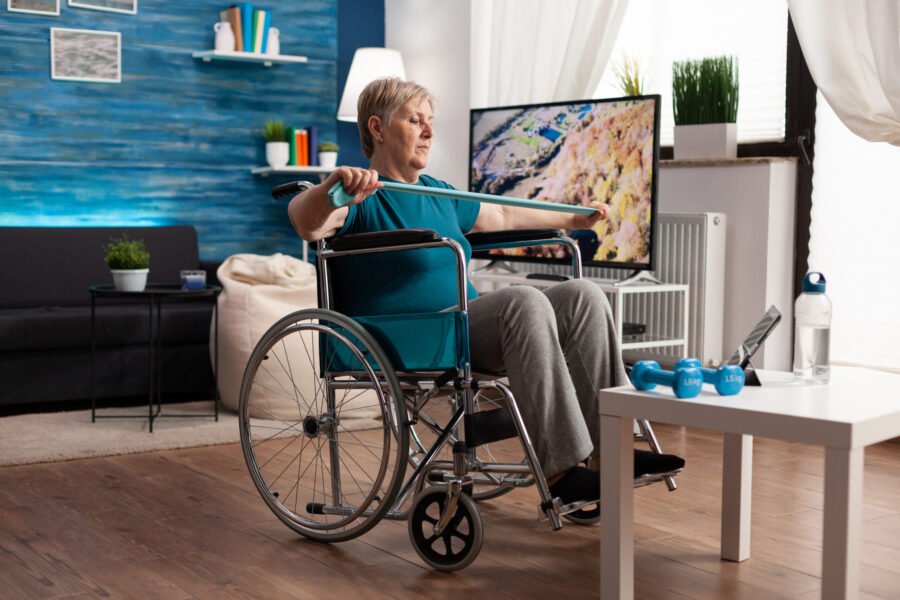
Maintaining movement and activity is important at every stage of life — especially for individuals who experience limited balance, reduced endurance, or fatigue with standing and walking. While traditional workouts may feel overwhelming, chair‑based exercises offer a safe, accessible way to stay active, engage muscles, and support overall mobility.
Chair‑based workouts meet people where they are. They allow movement without the fear of losing balance, provide a stable foundation, and can be adjusted to match individual energy levels. Best of all, these exercises can be done at home, in a clinic, or as part of a daily routine.
Why Chair-Based Exercise Matters
When balance or endurance is limited, people often reduce movement to avoid discomfort or falls. Unfortunately, reduced activity can lead to decreased strength, stiffness, and lower confidence with movement over time.
Chair‑based workouts help counter this cycle by:
- Encouraging consistent movement
- Supporting joint mobility and muscle engagement
- Helping maintain circulation and posture
- Building confidence in a controlled environment
- Providing an entry point toward more upright or supported movement
Small, regular movements can make a meaningful difference when practiced consistently.
Getting Started: Safety First
Before beginning any exercise routine, individuals should consider their comfort level and personal health situation. Movements should always feel controlled and intentional — not rushed or forced.
Helpful tips:
- Choose a sturdy chair that does not roll or slide
- Sit with feet flat on the floor whenever possible
- Move slowly and with control
- Stop if something feels uncomfortable or unsteady
- Focus on breathing throughout each movement
The goal is participation, not intensity.
Simple Chair-Based Exercises to Try
Below are examples of gentle, chair‑based movements that can help engage the body while maintaining a seated position. These exercises are not meant to replace professional guidance but to encourage safe, everyday movement.
- Seated Marching
Lift one foot a few inches off the floor, then lower it and switch sides.
This helps engage the hips and legs while reinforcing coordination.
- Seated Leg Extensions
Extend one leg forward until it is straight, then slowly lower it.
This supports thigh strength and knee mobility.
- Arm Raises
Lift one or both arms forward or overhead while staying seated.
This helps build upper‑body strength and encourages upright posture.
- Seated Truck Rotations
Gently rotate the upper body from side to side while seated.
This encourages spinal mobility and core engagement.
- Heel and Toe Raises
With feet flat on the floor, lift the heels, then the toes.
This supports lower‑leg activation and ankle mobility.
These movements can be performed in short sessions and repeated throughout the day.
Progressing Beyond the Chair
For many people, chair‑based workouts serve as an important foundation. As confidence and endurance improve, additional support tools — such as supported walk stations or therapy‑guided programs — may help bridge the transition from seated movement to more upright activity.
The key is progression that feels safe, intentional, and supportive.
Making Movement a Daily Habit
Consistency matters more than intensity. Even a few minutes of seated movement can:
- Reinforce daily routine
- Support strength and mobility
- Encourage a positive relationship with movement
- Help maintain independence and confidence
Movement does not need to be complicated to be beneficial.
Final Thoughts
Chair‑based workouts provide an inclusive and practical way to stay active for people with limited balance or endurance. By focusing on supported, accessible movement, individuals can take meaningful steps — at their own pace — toward maintaining strength, stability, and confidence.
Every movement counts, and every step forward begins with finding the right support. When you are ready to move beyond seated exercise, a supported walk station like WalkPort lets you practice walking with your body fully supported.